
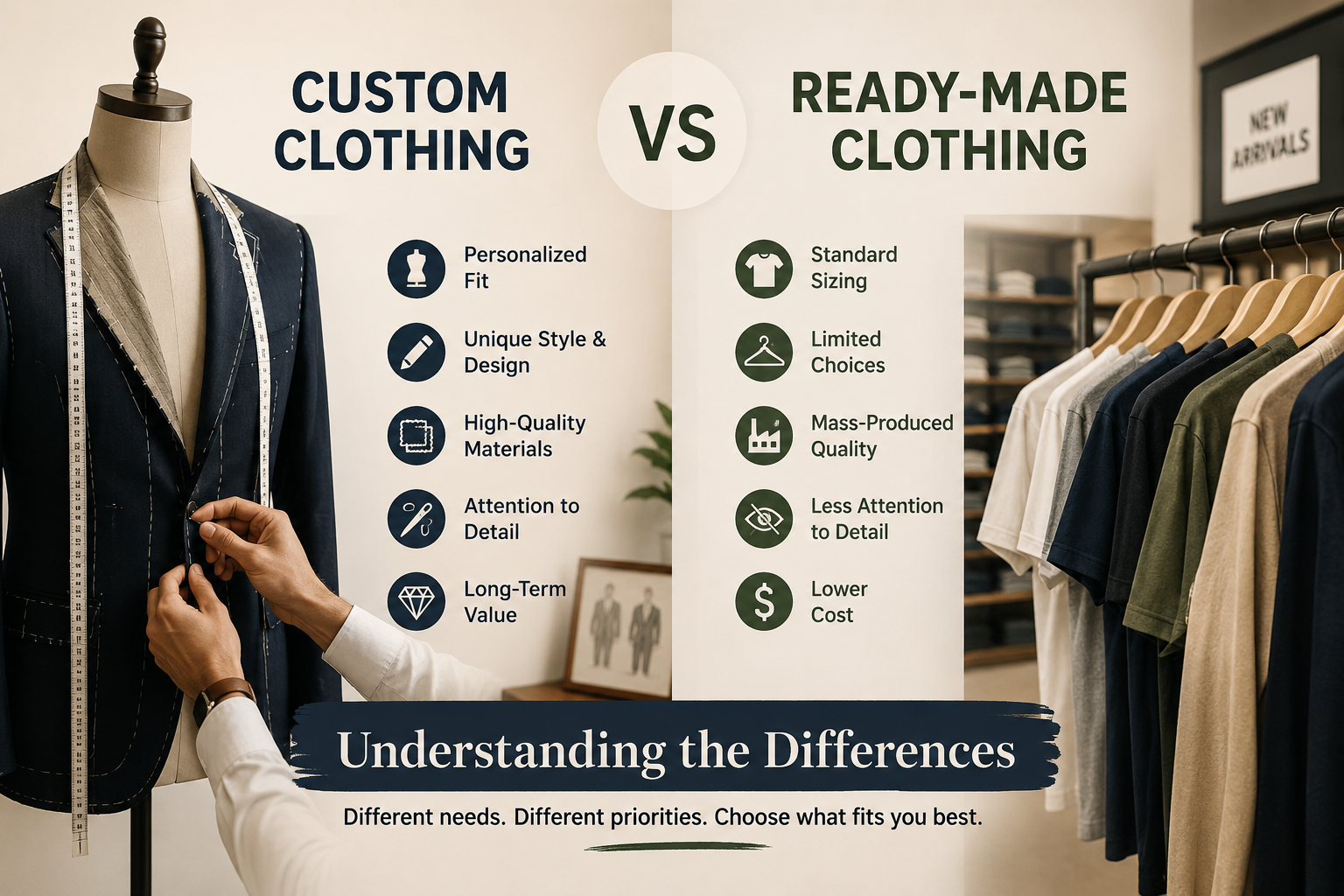
Both approaches have their place in a well-rounded wardrobe, and neither is universally “better” — the right choice depends heavily on the occasion, your timeline, your budget, and how particular you are about fit. A wedding outfit and a Tuesday work shirt simply don’t carry the same expectations. By the end of this guide, you’ll have a clear framework for deciding which route makes sense for any given garment, rather than defaulting to habit.
What Is Custom Clothing?
Every wardrobe decision eventually comes down to one question: do you buy something already made, or do you have something made for you? At Medhini Boutique, we sit at the intersection of this choice every single day — helping brides, family members, and everyday clients decide between custom clothing and ready-made clothing. This guide breaks down the real differences in fit, quality, cost, and convenience, so you can make the right call for your next outfit.
Custom clothing refers to garments created specifically for one person, based on their individual measurements, fabric choices, and design preferences. Unlike clothes pulled off a store rack, every element — from the cut of the neckline to the type of stitching — is decided around the wearer.
How the Custom Clothing Process Works
The process usually starts with a consultation, where measurements are taken and design preferences discussed. A pattern is then drafted or adjusted, fabric is selected, and the garment is constructed — often with one or more fitting sessions along the way to refine the final shape.
This back-and-forth is what sets custom clothing apart from anything bought off a shelf. Instead of choosing the closest available size and living with minor compromises, you and your tailor work together to correct fit issues as they appear — adjusting a shoulder seam, taking in a waist, or lengthening a hem — until the garment sits exactly the way it should. For more elaborate pieces like bridal wear, this can mean two or three fittings spread across several weeks.
Types of Custom Clothing
Made-to-Measure: This starts from an existing base pattern, which is then adjusted to an individual’s measurements. It’s faster and more affordable than fully bespoke work, while still offering a noticeably better fit than standard sizing. Learn more about made-to-measure clothing.
Bespoke: Built entirely from scratch around one person, bespoke garments involve original pattern-making, multiple fittings, and a high degree of handwork. It’s the most personalized — and most labour-intensive — form of custom clothing. Read more about the history of bespoke tailoring.
What Is Ready-Made Clothing?
Ready-made clothing — also known as ready-to-wear — refers to garments manufactured in advance, in a fixed range of standard sizes, and sold as-is in stores or online.
How Ready-Made Clothing Is Produced
Ready-made garments are produced in bulk using standardized size charts and templated patterns, allowing manufacturers to make large quantities quickly and at lower individual cost.
Common Categories of Ready-Made Apparel
This includes everyday wear, formal wear, and increasingly, semi-customizable occasion wear — where a base garment is ready-made but allows minor alterations.
Within ready-to-wear, there’s also a meaningful quality spread — from budget fast-fashion racks to higher-end designer labels that still follow standard sizing but use better fabric and finishing. Understanding where a piece sits on that spectrum matters just as much as the custom-versus-ready-made decision itself, since a well-made ready-to-wear garment can sometimes outperform a poorly executed custom one.
Advantages of Custom Clothing
Perfect Fit
Custom clothing is built around your actual body — not an average. This means better matching to your individual proportions, fewer awkward gaps or tightness, and far less need for post-purchase alterations.
This matters more than people often expect. Standard size charts are built around statistical averages, which means almost no one fits a size chart perfectly across every measurement. You might be a perfect size 36 at the bust but need extra room at the hips, or have arms slightly longer than the standard sleeve length. Custom clothing accounts for all of this simultaneously, rather than forcing a single compromise size.
Personalized Style
You choose the fabric, the silhouette, and the finer design details — giving you a garment that’s genuinely unique rather than one of thousands of identical pieces.
For bridal and occasion wear especially, this freedom extends to things like neckline shape, sleeve length, border width, and embellishment placement — details that ready-made collections simply can’t offer at scale, since every variation adds production complexity.
Superior Quality
Custom pieces are typically made with premium fabrics, more careful craftsmanship, and stronger stitching, since each garment receives individual attention rather than assembly-line treatment.
A tailor working on a single piece can afford to reinforce stress points, finish seams by hand, and catch small flaws before they become permanent problems — a level of quality control that’s difficult to replicate at mass-production speed and pricing.
Sustainability Benefits
Because custom garments are made to order, they generate less fabric waste and align more closely with a slow fashion approach — favouring fewer, longer-lasting pieces over disposable trends.
There’s also a longevity argument here: a well-made custom garment, properly cared for, can remain wearable for years or even decades, while mass-produced pieces are often designed around shorter trend cycles and replaced more frequently.
Drawbacks of Custom Clothing
Custom clothing isn’t without trade-offs. It typically comes with a higher initial cost, a longer waiting time, and the need for multiple fittings, which can extend the timeline further. Pricing can also vary significantly depending on the complexity of the design and the fabric chosen.
If you’re working against a tight deadline — say, a wedding that’s only a few weeks away — custom clothing can become a logistical challenge rather than a luxury. It’s worth building in buffer time for at least one fitting adjustment, since even experienced tailors occasionally need a second pass to get a complex garment exactly right.
Advantages of Ready-Made Clothing
Convenience
Ready-made clothing is available instantly — you can try it on and walk out wearing it the same day, with no waiting period.
Affordability
Mass production keeps per-unit costs low, and pricing is usually transparent and fixed, making budgeting simple.
Because pricing isn’t dependent on individual fabric quantities or labour hours, you also know exactly what you’re paying upfront — there’s no risk of additional charges for fitting adjustments or design changes partway through.
Trend Availability
Retailers move quickly to stock the latest styles, giving shoppers immediate access to current trends across a wide variety of designs.
Drawbacks of Ready-Made Clothing
Limited Sizing
Standard size charts can’t account for individual body variation, which often means compromising on fit in at least one area of the garment.
This is especially noticeable in structured garments like blouses and jackets, where even small fit issues — a tight armhole, a gaping neckline — are hard to ignore and often require a trip to a tailor anyway, partially offsetting the time saved by buying ready-made.
Lack of Individuality
Since the same design is produced in volume, there’s a real chance of seeing someone else in the exact same outfit.
Lower Durability
To keep costs down, ready-made garments — particularly in the fast fashion segment — often use cheaper materials and construction, which can affect how long the piece lasts.
Made-to-Measure vs Bespoke Clothing
Both fall under “custom clothing,” but they aren’t the same thing. Made-to-measure adjusts an existing pattern to your measurements — quicker and more accessible. Bespoke is built from a completely original pattern, involves extensive handwork, and usually requires several fitting sessions. The trade-off is simple: made-to-measure offers a faster, more affordable path to better fit; bespoke offers the highest level of personalization, at a higher cost and longer timeline.
Key Differences Between Made-to-Measure and Bespoke
- Starting point: made-to-measure begins with a standard block pattern; bespoke starts from a blank slate, drafted specifically for one person.
- Turnaround time: made-to-measure is typically faster to produce, since less of the pattern work is done from scratch.
- Cost: bespoke commands a premium due to the labour-intensive process and the level of individual attention involved.
- Best suited for: made-to-measure works well for most occasion wear; bespoke is usually reserved for flagship pieces like bridal lehengas or heavily detailed blouses, where the design is too specific for any existing pattern to be a reasonable starting point.
When Should You Choose Custom Clothing?
Custom clothing makes the most sense for weddings and bridal wear, special events and formal occasions, and situations involving unique body measurements that standard sizing doesn’t serve well. It’s also the right call whenever premium fabric and finish matter more than speed or price.
At Medhini, this is where most of our work lives — particularly through our Bridal Wear Customization and Designer Blouse Stitching services, where every measurement and design detail is worked out around the individual bride.
Even outside weddings, custom clothing is worth considering for any garment you expect to wear repeatedly over the long term — a signature blazer, a go-to festive saree blouse, or a piece meant to be passed down. The upfront investment pays off across the number of times it’s worn.
When Should You Choose Ready-Made Clothing?
Ready-made clothing is the better fit for daily wear, short-notice purchases, budget-conscious shopping, and chasing fast-moving trends where speed matters more than a perfect fit.
It also makes sense for garments you’re unsure about long-term — trying out a new silhouette or colour before committing to a custom version, for instance — since the lower cost reduces the risk of a style choice you later regret.
Key Factors to Consider Before Choosing
Before deciding, weigh four things: the occasion type (wedding, party, or daily wear), your timeline (planned well in advance, or an urgent need), your body shape and fit needs (including any recent size fluctuations), and your budget.
A useful rule of thumb: the more significant and infrequent the occasion, the more custom clothing tends to make sense. The more routine and frequent the need, the more ready-made clothing tends to win on practicality.
Custom Clothing vs Ready-Made Clothing: Comparison Table
| Factor | Custom Clothing | Ready-Made Clothing |
| Fit | Personalized | Standard Sizes |
| Style | Fully Customizable | Limited Options |
| Quality | Higher | Varies |
| Cost | Higher | Lower |
| Availability | Longer Wait | Immediate |
| Sustainability | Better | Less Sustainable |
| Uniqueness | High | Low |
| Durability | Higher | Moderate |
Cost Considerations: What Drives the Price Difference?
Custom clothing costs more for a few clear reasons: dedicated labour time for one garment instead of hundreds, premium fabric sourcing, and the back-and-forth of fittings. Ready-made clothing keeps costs down by spreading design, cutting, and stitching labour across a large batch, which is why a similar-looking piece can cost a fraction of the custom equivalent.
That said, the price gap narrows when you factor in alteration costs on the ready-made side, and widens or shrinks on the custom side depending on fabric choice — a simple cotton custom piece can sometimes cost less than a heavily embellished ready-made one. It’s worth getting a clear quote upfront rather than assuming either option is automatically cheaper.
Medhini’s Approach to Custom Fit
Every custom piece at Medhini begins with a one-on-one consultation, where we take detailed measurements and talk through fabric, silhouette, and occasion. From there, our team works through fittings to refine the final garment — whether it’s a full bridal ensemble or a single designer blouse. If something needs adjusting after the fact, our Alterations & Repairs service is there to fine-tune the fit further.
We also work closely with clients on the Styling Consultation side of things, helping translate a general idea — “something in Kerala kasavu, but modern” — into a concrete design brief before any fabric is cut. That early clarity is often what separates a custom piece that feels effortless from one that needed several rounds of correction.
Which Option Is Right for You?
If perfect fit, quality, and personalization matter most — especially for a wedding or special occasion — custom clothing is worth the investment. If convenience, affordability, and quick availability matter more — for daily wear or last-minute needs — ready-made clothing is the practical choice. In most wardrobes, the two aren’t competitors; they’re complementary, each suited to different moments in your life.
The healthiest approach is usually a mix: lean on ready-made for the everyday, and reserve custom clothing for the pieces that matter enough to deserve the extra time, cost, and attention.
Thinking about a custom fitting for your wedding or next occasion?
Book a Consultation on WhatsApp
Frequently Asked Questions
Is custom clothing worth the extra cost?
For occasions where fit and quality matter — like weddings — yes. The better fit, premium materials, and longer lifespan often justify the higher price, especially for a garment you’ll wear in photographs that last a lifetime.
What is the difference between bespoke and made-to-measure?
Made-to-measure adjusts an existing pattern to your measurements; bespoke is built from an entirely original pattern with more handwork and fittings. Made-to-measure is faster and more affordable, while bespoke offers the deepest level of personalization.
Does custom clothing last longer?
Generally yes, due to better fabric quality and stronger construction compared to most mass-produced garments. With proper care, a well-made custom piece can remain wearable for many years.
Why does ready-made clothing fit differently?
It’s built to standard size charts designed to fit an average body shape, not your specific proportions — which is why two people wearing the “same size” can still look and feel different in the same garment.
Which is better for weddings: custom or ready-made?
Custom clothing is generally better suited for weddings, given the importance of fit, fabric, and personalization on the day. Most boutiques, including Medhini, recommend starting the process well in advance to allow time for fittings.
Can ready-made clothing be altered for a better fit?
Yes, minor alterations can improve fit, though they can’t fully replicate the precision of a garment made to your measurements from the start. Alterations work best for small adjustments rather than major structural changes.
Is custom clothing more sustainable?
Generally yes — made-to-order production reduces fabric waste and overproduction compared to mass manufacturing, and custom garments tend to be kept and worn for longer.
How long does custom tailoring usually take? It varies by complexity, but most custom garments take anywhere from a couple of weeks to a few months, especially for bridal wear involving heavy embellishment
