
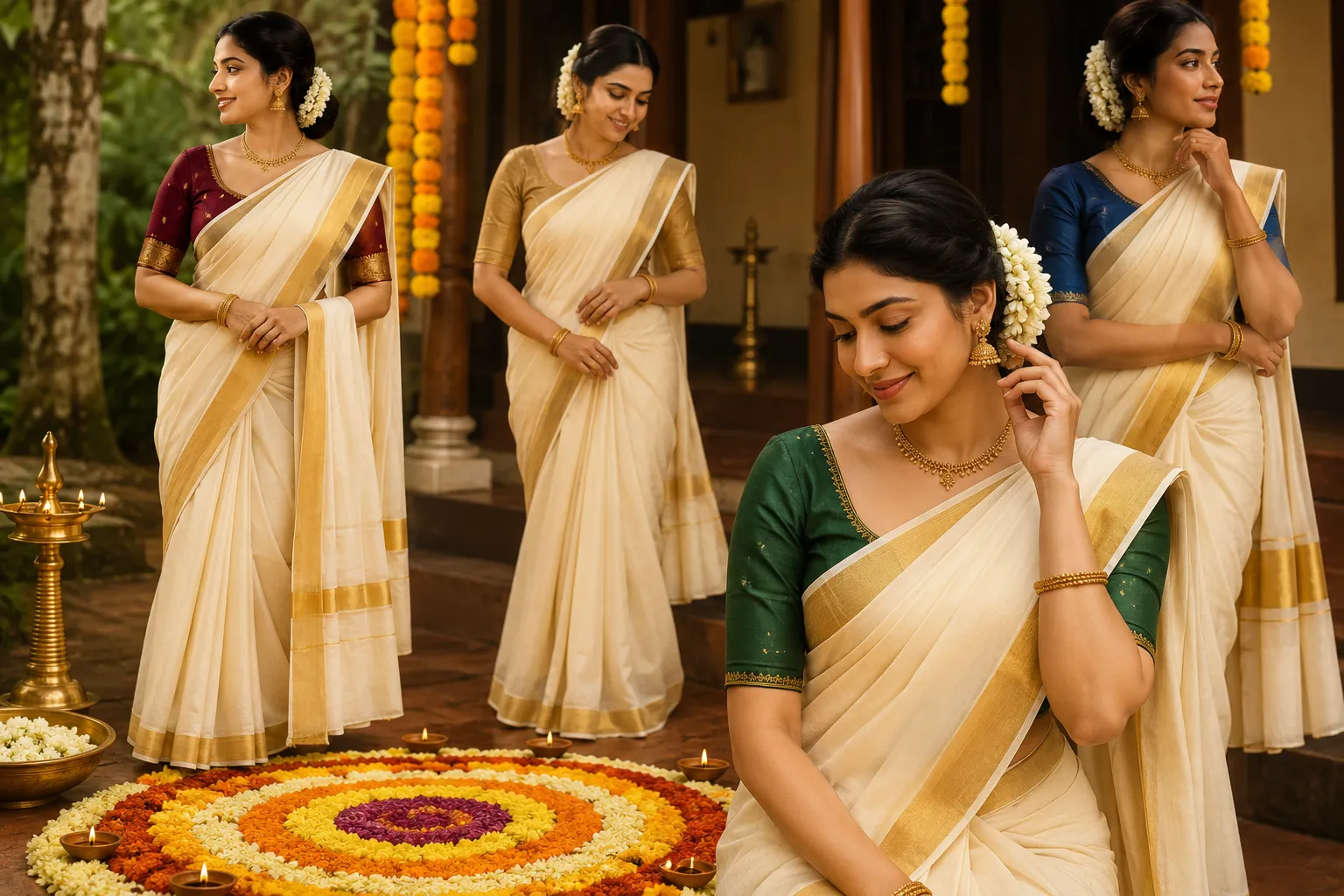
A head-to-toe guide to sarees, blouses, jewellery, draping and gifting — for the woman who wants Onam to look effortless.
Why Onam Styling Matters as Much as the Saree
Every Onam, one image repeats across Kerala. A woman in a cream-and-gold Kasavu saree stands beside a pookalam. Jasmine sits in her hair. This look has survived generations. It is simple. It is dignified. And it photographs just as beautifully in real life as it does on a screen.
But there is a difference between owning a Kerala saree and knowing how to wear one well. The saree is only the starting point. The blouse you pair it with matters. So does the jewellery you choose. The way you drape the pallu and style your hair changes the whole look. Together, these choices separate a look that feels borrowed from one that feels like yours.
What This Guide Covers
This guide walks through the complete Onam styling journey. You’ll learn how to choose the right Kerala saree and pick a blouse that flatters your body. We’ll cover jewellery, hair, and footwear, plus how to get the drape right. We’ll also look at styling for different occasions, from weddings to office parties. Along the way, we’ll point you to where Medhini Boutique can help — whether that’s a saree from our handloom collection or a one-on-one styling consultation before the big day.
Choosing the Right Kerala Saree for Onam
The Kerala saree is deceptively simple. There is no dense embroidery to hide behind. There is no riot of colour to distract the eye. This means the fabric, the border, and the drape have to do all the work. Getting the saree right is the foundation everything else is built on.
Classic Kasavu Sarees
The Kasavu saree is Kerala’s signature. It has an ivory or off-white cream base with a golden zari border. The border usually runs along the edge of the pallu. Sometimes it runs along the full length of the saree too. The gold is traditionally real zari, a fine metallic thread historically woven with silver dipped in gold. Most sarees today use a more affordable tested zari alternative. It still catches the light beautifully.
This colour combination isn’t just a fashion choice. It’s tied to Kerala’s cultural identity. Cream represents purity and simplicity. Gold represents prosperity. Both values connect closely to Onam as a harvest festival of abundance. Wearing a Kasavu saree during Onam isn’t really a style statement. It’s a continuation of a tradition that predates the current fashion cycle by centuries.
Choosing the Right Fabric
Pure Cotton — Lightweight, breathable, and ideal for Kerala’s humid climate. Pure cotton Kasavu sarees are the most traditional choice for daytime Onam events. They work well for pookalam-making and Onasadya, where you’ll sit on the floor for long stretches.
Cotton Silk — A blended fabric that gives you the crispness of cotton with a subtle sheen closer to silk. It drapes slightly better than pure cotton and holds pleats more securely. This makes it a good middle-ground choice for a dressier look without full silk’s weight or price.
Tissue Sarees — Woven with a fine metallic thread running through the fabric itself, tissue sarees have a soft shimmer that catches light beautifully in photographs. They work well for evening Onam events, receptions, or festive workplace celebrations.
Soft Silk — For weddings, formal family functions, or the grandest Onam gathering of the year, a soft silk Kasavu saree gives you richer texture and more structured pleats. The drape is heavier and more luxurious, though it runs warmer through a full day of festivities.
Authentic Kerala Handloom Sarees
If you want a saree with real heritage value, look for handloom weaves from two specific regions.
- Kuthampully weaves — from a small weavers’ village near Thrissur, known for fine, tightly woven cotton with intricate temple borders and traditional motifs.
- Balaramapuram craftsmanship — one of the oldest handloom traditions in Kerala, historically supplying sarees to Travancore royalty, recognisable by its superior cotton count and precise zari work.
Both Kuthampully and Balaramapuram sarees carry a Geographical Indication (GI) tag. This is a certification from the Government of India. It confirms the saree was woven in that specific region using traditional methods. A GI tag is your assurance of authenticity. It tells you that you’re buying a real handloom piece, not a power-loom imitation sold under the same name.
✦ Explore Medhini Boutique’s Kerala Saree Collection — handloom-authentic Kasavu sarees in cotton, cotton silk, tissue, and soft silk.
Best Blouse Styling Ideas for Kerala Sarees
A Kasavu saree’s understated palette means the blouse carries more visual weight than it would with a printed or embroidered saree. This is where you can bring in colour, personality, and a hint of modern styling without disturbing the traditional base.
Timeless Gold Blouses
A gold or antique-gold blouse mirrors the saree’s zari border. It keeps the entire look tonal and elegant. This is the safest and most classic pairing. It looks effortlessly put-together without any decision fatigue, and it photographs exceptionally well next to the cream of the saree.
Festive Colour Combinations
If gold-on-cream feels too monochrome for your taste, a contrast blouse is where Kerala saree styling gets interesting. The trick is picking colours saturated enough to stand up against the gold border. They shouldn’t clash with it.
- Emerald Green — cool, rich, and strongly associated with Onam’s greenery and banana-leaf sadya; one of the most popular contrast choices.
- Maroon — deep and regal, pairs beautifully with gold zari and works for both daytime and evening events.
- Ruby Red — bold and auspicious, a favourite for weddings and receptions.
- Royal Blue — a striking, modern contrast that photographs particularly well in outdoor Onam settings.
- Mustard Yellow — warm and harvest-toned, echoing Onam’s agricultural roots while still feeling contemporary.
Modern Blouse Designs
The blouse silhouette is where you can update the look for 2026 without touching the saree itself.
- Embroidered sleeves — delicate thread or zari embroidery along the sleeve edge adds detail without overwhelming the saree’s simplicity.
- Boat neck — a wide, shallow neckline that feels polished. It works well for both petite and fuller frames.
- High neck — a more conservative, structured option. It pairs nicely with statement earrings since it keeps the neck bare.
- Sleeveless — a cooler, contemporary choice for warm Onam afternoons, especially with heavier silk sarees.
- Halter neck — a distinctly modern silhouette for younger brides and Onam parties with a fashion-forward dress code.
✦ Customize Your Perfect Onam Blouse — Medhini Boutique’s designer blouse stitching service tailors colour, neckline, and sleeve style to your saree and body type.
Accessories That Complete the Look
Because the saree itself is restrained, accessories do most of the work in signalling festivity. The goal is layering with intention — enough to feel celebratory, not so much that it competes with the saree’s simplicity.
Traditional Kerala Jewellery
- Kasu Mala — a necklace of gold coin-like discs (kasu). It’s one of the most recognisable pieces of Kerala jewellery and an instant way to anchor the traditional look.
- Mullamottu Mala — a delicate necklace styled to resemble jasmine buds, often layered with a Kasu Mala for a fuller neckline.
- Jhumkas — bell-shaped gold earrings that pair naturally with the saree’s zari tones. They work whether your blouse is plain or detailed.
- Bangles — traditional gold bangles, worn in a stack, complete the arm without needing anything more elaborate.
- Oddiyanam — a waist belt worn over the saree, traditionally reserved for weddings and grand occasions. It’s increasingly worn at big Onam celebrations too.
A useful rule of thumb: if you’re wearing a Kasu Mala, let it be the centrepiece. Keep everything else — earrings, bangles, waist belt — as a supporting note, not a second statement piece.
Hairstyles
- Fresh jasmine flowers — pinned along a bun or braid, jasmine is Onam’s signature finishing touch. It pairs with almost any hairstyle.
- Gajra — a woven string of jasmine or mixed flowers wrapped around a bun. It gives a fuller, more textured floral finish than loose flowers.
- Traditional bun — a low, neat bun at the nape of the neck, the most classic pairing with a Kasavu saree.
- Soft braids — a loose side braid or fishtail. It’s a softer, more contemporary alternative to the traditional bun, especially for younger women or day events.
Footwear
Traditional juttis — flat, embroidered ethnic footwear that stays true to the overall aesthetic. It’s comfortable for long hours of standing during sadya and cultural programs.
Comfortable flats — for a full day of Onam events, especially pookalam-making or outdoor games, simple gold or nude flats are a practical choice. They don’t compromise the look.
Kerala Saree Draping Tips
How you drape a Kerala saree changes its entire character. The traditional method reads as classic and formal. Modern draping styles offer more convenience and a slightly different silhouette.
Traditional Draping
- Uniform pleats — pleats should be even in width and pressed flat before tucking, since plain cotton or silk shows any irregularity clearly.
- Natural pallu — the pallu is typically left to fall naturally over the left shoulder rather than pleated and pinned. This gives the saree its characteristic soft, unstructured drape.
- Left shoulder drape — unlike some regional styles, the Kerala saree pallu is conventionally worn over the left shoulder. This frames the gold border across the chest.
Modern Styling Ideas
- Pre-stitched sarees — a pre-pleated, ready-to-wear version that eliminates draping time entirely. A practical option if you want the look without the skill or time investment.
- Seedha pallu — the pallu is brought forward over the right shoulder instead of the left. This displays the border and any blouse detailing at the back, a popular choice for photographs.
- Ethnic jackets — a short embroidered jacket or cape worn over the blouse adds a contemporary layering element, especially for evening Onam events.
- Waist belts — worn over the pleats at the waist, a belt adds definition to the silhouette. It works well with both traditional and pre-stitched drapes.
✦ Book a Personal Styling Consultation — Medhini Boutique’s stylists can help you choose a draping style suited to your saree, body type, and the occasion.
Styling Kerala Sarees for Different Occasions
The same Kasavu saree can be styled up or down depending on where you’re wearing it. Here’s how the look shifts across Kerala’s most common festive occasions.
Onam Celebration
For the main Onam day, Thiruvonam, the classic combination holds. Wear a pure cotton or cotton silk Kasavu saree with a gold or contrast blouse. Add a Kasu Mala and jasmine in the hair. Choose comfortable footwear for a day that involves pookalam, sadya, and often outdoor games.
Vishu Festival
Vishu calls for a similarly traditional look. Sarees are sometimes paired with slightly brighter blouse colours to match the festival’s association with new beginnings and the ceremonial Vishukkani.
Weddings & Receptions
For weddings, soft silk Kasavu sarees with heavier zari work take precedence over cotton. This is where an Oddiyanam waist belt comes into its own. A fuller jewellery set and a more elaborate hairstyle with a full gajra complete the look.
Office Celebrations
Workplace Onam celebrations call for a scaled-down version of the look. Choose a cotton or cotton silk saree with minimal jewellery, just jhumkas and bangles, and a neat bun. It’s festive enough to mark the occasion without feeling out of place at a desk.
Community Events
Local Onam programs, cultural performances, and neighbourhood celebrations are the most flexible occasions stylistically. They’re a good opportunity to experiment with a tissue saree or a modern blouse silhouette without the higher stakes of a wedding.
Family Matching Outfit Ideas
Coordinated family dressing has become one of the most photographed parts of Onam. It doesn’t require identical outfits, just a shared colour or fabric thread running through everyone’s clothing.
Mother-Daughter Matching
The easiest way to coordinate is through the blouse colour rather than the saree itself. If the mother wears an emerald green blouse with her Kasavu saree, the daughter’s mini Kasavu saree or pavada-blouse set can pick up the same green.
Mundu & Kurta for Men
Men typically pair a cream Kasavu mundu, the traditional Kerala dhoti with a gold border, with a matching cream or off-white kurta or shirt. This keeps the family’s colour palette consistent without an exact match.
Mini Kasavu Sarees for Kids
Young girls can wear scaled-down Kasavu sarees or pavada-blouse sets. Young boys wear miniature mundus. This lets the whole family carry the same cream-and-gold thread through every generation in the frame.
Kerala Saree Gifting Guide
Kasavu sarees are also one of the most popular Onam gifts. They work well for mothers, mothers-in-law, or as a thoughtful gesture to close friends and colleagues.
Curated Gift Boxes
A saree presented in a well-put-together box reads as more considered than a saree alone. Sometimes a matching blouse piece is included too.
Saree Starter Kits
For someone new to Kerala sarees, a starter kit works well. Include a saree, a blouse piece, and a simple styling note on draping. This makes the gift genuinely usable rather than something that sits in a cupboard.
Personalized Gift Notes
Add a short handwritten note about why you chose that particular saree. Mention the weave, the region it comes from, or the occasion it suits. This adds a layer of meaning that a plain gift tag doesn’t.
✦ Shop Authentic Handloom Kasavu Sarees at Medhini Boutique — ready-to-gift options with curated packaging available on request.
Caring for Your Kerala Saree
A Kasavu saree needs a slightly different care routine than everyday clothing, especially one with real or tested zari. The golden border is the first thing to dull or fray if handled carelessly.
Silk Saree Care
- Dry cleaning — soft silk and tissue sarees should be dry-cleaned rather than washed at home, since water can affect the silk’s texture and the zari’s shine.
- Proper storage — silk sarees should be folded along their original fold lines. Refold periodically to prevent permanent creasing along one line.
Cotton Saree Care
- Gentle hand wash — pure cotton and cotton silk sarees can usually be hand-washed in cold water with a mild detergent. Avoid machine washing, which can fray the zari border.
- Shade drying — dry in shade rather than direct sunlight. Sun can yellow the cream base over time and dull the gold zari.
Storage Tips
- Muslin cloth — wrap sarees in muslin or cotton cloth rather than plastic covers. Plastic traps moisture and can weaken the fabric over time.
- Avoid sunlight — store sarees away from direct light, which fades the cream base and darkens zari unevenly.
- Prevent moisture — keep a few silica gel packets or neem leaves in your saree cupboard during Kerala’s monsoon and humid months to prevent mildew.
Common Styling Mistakes to Avoid
A few small missteps can throw off an otherwise well-chosen Kerala saree look. Here’s what to watch for.
- Wearing too much jewellery — a Kasu Mala, jhumkas, bangles, and an Oddiyanam all at once can overwhelm the saree’s simplicity. Pick a centrepiece and let the rest support it.
- Choosing the wrong blouse fit — a blouse that’s too loose or too tight distracts far more on a plain saree than a printed one. Get it tailored rather than buying off-the-rack.
- Incorrect pleats — uneven or too-thin pleats show clearly against the cream fabric. Take a few extra minutes to press and align them before pinning.
- Poor footwear choices — heavy, dark, or overly casual footwear breaks the visual line of a Kasavu saree. Stick to gold, nude, or traditional juttis.
- Over-accessorizing — resist adding a statement necklace, statement earrings, a waist belt, and a hair accessory all in one look. Simplicity is the whole point of the Kasavu aesthetic.
Frequently Asked Questions
Which Kerala saree is best for Onam?
A classic cream-and-gold Kasavu saree in pure cotton or cotton silk is the most traditional choice for Onam day. It suits both the pookalam and the sadya.
Which blouse colour matches a Kasavu saree?
Gold is the safest, most tonal choice. Emerald green, maroon, ruby red, royal blue, and mustard yellow are popular contrast colours for a more festive look.
Can I wear a Kerala saree without gold jewellery?
Yes. A Kasavu saree pairs well with minimal jewellery, like simple jhumkas and bangles. Fresh jasmine flowers alone also work for a lighter, more contemporary look.
Which fabric is best for Kerala’s climate?
Pure cotton is the most breathable option for Kerala’s humidity, ideal for daytime Onam events. Silk suits evening functions and weddings better.
How do I drape a Kerala saree traditionally?
The traditional drape uses uniform pleats tucked at the waist. The pallu is left to fall naturally over the left shoulder rather than pleated and pinned.
What hairstyle suits a Kerala saree?
A neat traditional bun or a soft braid works best. Finish it with fresh jasmine flowers or a gajra for the most classic pairing with a Kasavu saree.
How should I wash a Kerala cotton saree?
Hand wash in cold water with a mild detergent. Dry in shade rather than direct sunlight to protect the cotton and the gold zari border.
Can I wear a Kerala saree to office Onam celebrations?
Yes. A cotton or cotton silk Kasavu saree with minimal jewellery and a simple bun works well for the workplace. It strikes a balance between festive and professional.
The Final Word
A Kerala saree does most of the work on its own. But the right blouse, the right jewellery, and a confident drape are what turn it into a complete look. If you’d rather have an expert guide you through these choices before Onam, Medhini Boutique’s styling consultation and designer blouse stitching services are built exactly for this.
✦ Contact Our Fashion Experts for saree recommendations, blouse customization, or a full Onam styling consultation.
