
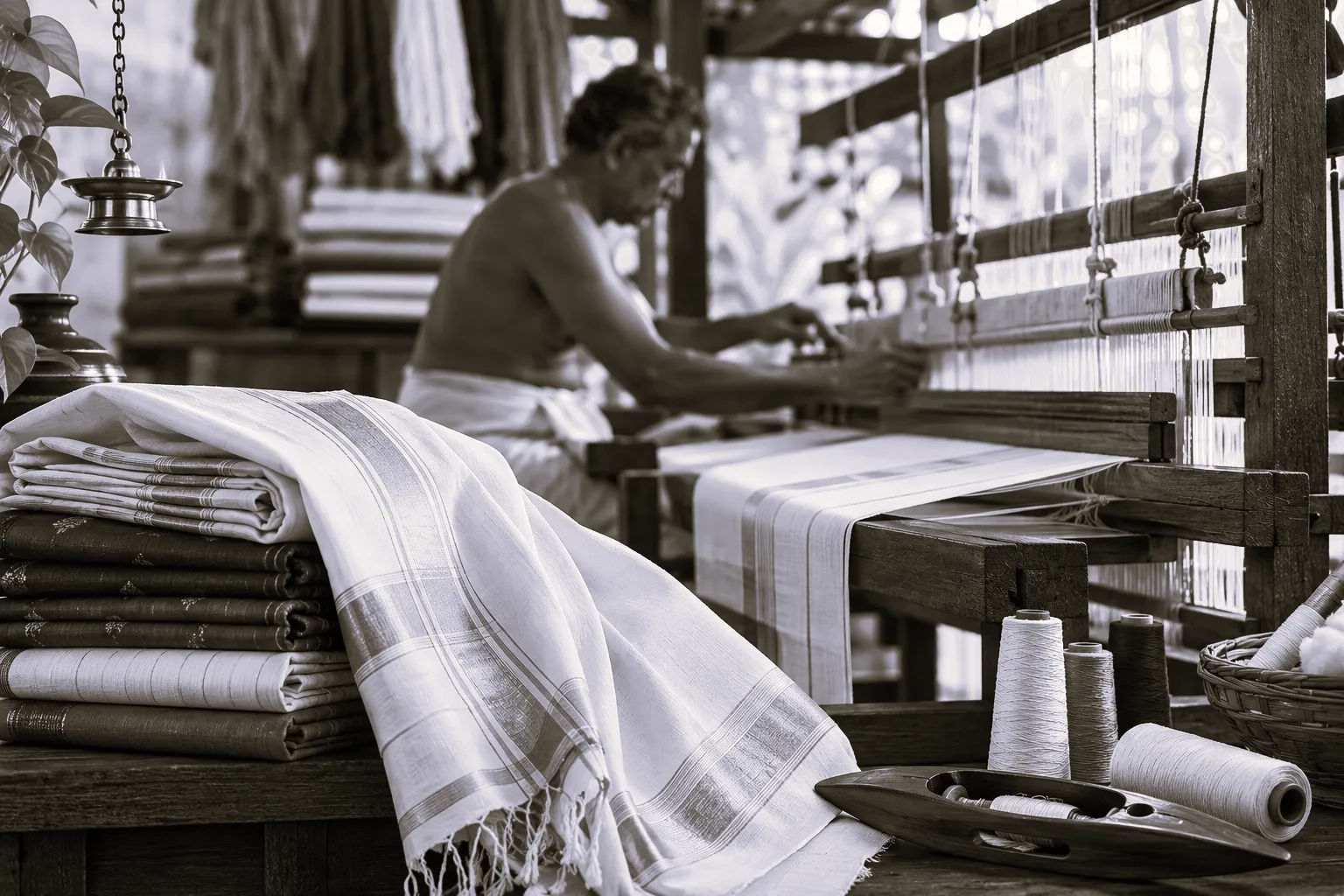
If you have ever run your fingers over a genuine Kuthampully saree and felt that unmistakable crisp-yet-soft cotton weave shimmering with a gold or silver border, you already know why this small Kerala village has become synonymous with handloom excellence. Kuthampully Handlooms is not just a product category — it is a living tradition, carried forward by generations of weavers in a single village in Thrissur district, Kerala.
In this guide, we cover everything you need to know about Kuthampully handlooms: their history, the community behind them, the fabrics and designs, how to identify authentic pieces, when to wear them, and where to buy genuine products. Whether you are an Onam shopper, a bride planning her trousseau, a tourist exploring Kerala’s textile heritage, or a boutique owner sourcing handloom collections, this is the only guide you’ll need.
What Is Kuthampully Handlooms?
Kuthampully Handlooms refers to the handwoven textiles produced in Kuthampully village, near Kollamkode in Thrissur district, Kerala. The village is home to a community of traditional weavers whose looms produce some of the finest Kerala handloom sarees, mundus, and set-saree ensembles in the state.
What sets Kuthampully apart from other handloom clusters is its unbroken continuity of craft. Almost every household in the village has a functioning handloom, and weaving here isn’t a revived heritage craft — it is a living occupation passed down through families for well over a century.
Why Kuthampully Handlooms Are Famous
Kuthampully’s fame rests on a few defining qualities:
- Pure cotton weaving with a texture that is breathable, durable, and naturally suited to Kerala’s tropical climate
- Gold and silver kasavu borders woven directly into the fabric rather than printed or embellished afterward
- Intricate temple borders and traditional motifs unique to the region
- GI (Geographical Indication) recognition, which legally protects the “Kuthampully” name for genuine handloom products from this village
- Trusted quality built over decades of consistent craftsmanship
Importance in Kerala Culture
The Kuthampully saree, more commonly worn in its “set saree” (mundum neriyathum) form, is deeply woven into Kerala’s cultural identity. It is the outfit of choice for Onam, Vishu, weddings, temple functions, and classical dance performances like Mohiniyattam and Bharatanatyam. The cream-and-gold palette reflects Kerala’s traditional aesthetic — understated, elegant, and rooted in the state’s kasavu weaving heritage.
For many Malayali families, owning at least one authentic Kuthampully piece is considered essential, whether inherited from an older generation or bought fresh for a milestone celebration.
History and Heritage of Kuthampully Handlooms
Origin of Kuthampully Village
Kuthampully is a small village located in Thrissur district, one of Kerala’s most culturally rich regions and often referred to as the state’s cultural capital. The village’s identity has, for generations, been built around handloom weaving rather than agriculture or trade, making it distinct among neighboring settlements.
The exact origins of weaving in Kuthampully trace back to a migration story that shaped the village’s economic and cultural fabric — quite literally.
The Devanga Chettiar Community
The weavers of Kuthampully belong primarily to the Devanga Chettiar community, a traditional weaving community that migrated from Tamil Nadu generations ago and settled permanently in this part of Kerala. Bringing with them specialized weaving skills, the community adapted their craft to suit Kerala’s specific textile preferences — particularly the demand for pure cotton fabric with gold zari (kasavu) detailing rather than the heavier silk work common in Tamil Nadu.
This cultural blending is part of what makes Kuthampully handloom so distinctive: it carries the technical precision of Tamil weaving traditions combined with the aesthetic sensibilities of Kerala’s kasavu heritage.
Over generations, the Devanga Chettiar families in Kuthampully have trained their children in the craft, ensuring that weaving skills — from thread preparation to loom-setting to the final finishing touches — remain within the community and within the village itself.
Society Registration in 1972
A significant milestone in Kuthampully’s history came in 1972, when local weavers formally organized themselves into a registered handloom weavers’ society. This move helped:
- Standardize quality and pricing
- Provide collective bargaining power for raw materials
- Create structured employment for weaver families
- Lay the groundwork for future recognition and protection of the craft
This society-based model is still central to how much of Kuthampully’s handloom production operates today, with many weavers working under cooperative societies alongside independent producers and private looms.
GI Tag Recognition (2011)
In 2011, Kuthampully handlooms received official Geographical Indication (GI) tag recognition under India’s Intellectual Property Rights framework. This is one of the most important developments in the product’s modern history.
A GI tag legally certifies that a product’s qualities, reputation, or characteristics are essentially attributable to its geographical origin. For Kuthampully, this means:
- Only handloom products genuinely woven in Kuthampully village can carry the “Kuthampully” name commercially
- It protects local weavers from unauthorized use of the name by mass manufacturers or powerloom producers elsewhere
- It reassures buyers that a GI-tagged product has been verified for authenticity
- It elevates Kuthampully alongside other India’s GI-protected textiles, such as Kanjeevaram silk and Pochampally Ikat
For consumers, understanding the GI tag is one of the most reliable ways to distinguish real Kuthampully handloom from imitation products sold under the same name in the wider market.
Product Categories: What Kuthampully Handlooms Offer
Kuthampully weavers produce a wide and versatile product range that goes well beyond the classic saree. Here’s a breakdown by category.
Women’s Collection
Kerala Set Saree — The most iconic Kuthampully product: a two-piece drape consisting of a mundu (lower garment) and a neriyathu (upper drape), typically in cream with gold or silver kasavu borders.
Set Mundu — The mundu component sold separately or as part of a coordinated set, often paired with contrast blouses for a modern styling approach.
Dhavani — A traditional half-saree style popular for younger women and worn during cultural functions, often as a precursor to full saree draping.
Kasavu Kurti — A contemporary adaptation bringing the kasavu aesthetic into everyday, easy-to-wear silhouettes.
Salwar Sets — Kasavu-bordered salwar kameez sets that combine traditional textile identity with everyday comfort.
Soft Silk Sarees — A silk variant that retains the kasavu border tradition while offering a richer drape suited for weddings and formal events.
Pattu Sarees — Silk sarees woven with more elaborate zari work, typically reserved for bridal wear and grand occasions.
Men’s Collection
Double Mundu — The traditional two-piece mundu set worn by Kerala men for formal and festive occasions, often featuring a kasavu border on both pieces.
Shirts — Handloom cotton shirts, sometimes styled with subtle kasavu or temple-border detailing along the placket or cuffs.
Kurtas — Handwoven kurtas offering a fusion of traditional fabric with contemporary menswear silhouettes.
Shirt-Dhoti Combo — A coordinated set pairing a handloom shirt with a matching dhoti, popular for weddings and Onam celebrations.
Velcro Belt Mundu — A practical modern adaptation of the traditional mundu, designed for convenience without compromising on the handloom aesthetic.
Kids Collection
Pattu Pavada — A traditional silk skirt-and-blouse set for young girls, often worn during Onam, Vishu, and temple ceremonies.
Newborn Kasavu Dress — Delicate kasavu-bordered garments designed for infants, frequently used during naming ceremonies.
Boys Kurta Dhoti — A miniature version of the adult kurta-dhoti combo, letting young boys participate in festive traditions in age-appropriate handloom wear.
Materials and Fabrics Used in Kuthampully Handlooms
Understanding fabric composition is essential to appreciating — and correctly caring for — a Kuthampully handloom piece.
Pure Handloom Cotton
The foundation of Kuthampully’s reputation. Pure handloom cotton is breathable, moisture-wicking, and ideal for Kerala’s humid climate. It has a slightly textured, matte finish that’s instantly recognizable to those familiar with authentic handloom fabric, as opposed to the glossier finish typical of powerloom cotton.
Tissue Kerala Saree
A lighter, semi-sheer variant that incorporates a fine metallic thread running through the weave, giving the fabric a subtle shimmer. Popular for daytime wedding functions and Onam celebrations where a lighter drape is preferred.
Linen
Increasingly popular among Kuthampully weavers, linen blends offer a slightly heavier drape with a natural, earthy texture — well suited to contemporary, minimalist styling while retaining the handloom identity.
Mulmul Cotton
An ultra-soft, finely woven cotton variant known for its lightweight, almost gauze-like texture. It’s especially favored for daily-wear kasavu kurtis and children’s clothing due to its gentle feel against the skin.
Banarasi Silk
Some Kuthampully retailers also offer Banarasi silk sarees with kasavu-inspired borders, blending Kerala’s aesthetic sensibility with the richness of Banarasi brocade work — a popular choice for brides seeking a heavier, more opulent option.
Kanjivaram Silk
Similarly, Kanjivaram-style silk sarees with Kerala kasavu detailing cater to buyers who want the grandeur of South Indian silk weaving fused with Kerala’s traditional gold-border identity.
Seasonal and Occasion Suitability: Pure cotton and mulmul are best for daily wear and humid-weather festivals like Onam; tissue and linen suit semi-formal daytime events; silk variants (soft silk, pattu, Banarasi, Kanjivaram) are reserved for weddings, receptions, and grand celebrations.
Borders and Kasavu Designs: The Heart of Kuthampully Identity
The border is where a Kuthampully handloom truly distinguishes itself. Each border style carries its own visual character and cultural weight.
Gold Kasavu
The classic and most recognized border style, woven using gold-toned zari thread. Traditionally, this used real gold-dipped thread, though today most commercially available pieces use gold-toned metallic yarn that replicates the same rich look at an accessible price point.
Silver Kasavu
A cooler-toned alternative to gold kasavu, silver kasavu borders offer a more contemporary, understated shimmer. Increasingly popular among younger buyers looking for a modern twist on the traditional aesthetic.
Temple Borders
Named for their resemblance to temple gopuram (tower) architecture, temple borders feature a repeating triangular or stepped pattern along the saree’s edge. This is one of the most iconic and widely recognized Kerala saree border styles.
Kattikara Border
A distinct, densely woven border style known for its bold, substantial appearance. The kattikara border is often chosen for occasions demanding a more prominent, statement-making drape.
Puliyilakkara Design
Literally translating to “tamarind leaf design,” puliyilakkara borders feature a repeating leaf-shaped motif inspired by nature. This design carries strong cultural resonance in Kerala’s textile tradition and is prized for its delicate, organic detailing.
Cultural Importance: These border designs aren’t arbitrary decoration — many trace their origins to temple architecture, regional flora, and centuries-old aesthetic conventions specific to Kerala. Choosing a border style is, in many ways, choosing which visual language of Kerala’s heritage you want to wear.
Art and Design Elements
Beyond borders, Kuthampully handlooms showcase additional layers of craftsmanship.
Mural Painting Sarees
Inspired by Kerala’s famous temple mural art, these sarees feature hand-painted or woven depictions of mythological and devotional scenes, typically along the pallu or border. They represent one of the more artistically elaborate offerings within the Kuthampully product range.
Hand-Painted Sarees
Some sarees feature additional hand-painted embellishments applied after weaving, allowing for customized motifs, and often used for boutique-exclusive or limited-edition pieces.
Embroidery
Select pieces incorporate embroidery work — either as an accent to the kasavu border or as standalone detailing on blouses and dupattas — adding texture and dimension to the traditional palette.
Zari Work
Zari (metallic thread) work extends beyond just the border in premium pieces, sometimes appearing as scattered motifs across the body of the saree (known as “buttis”) for a richer, more festive look.
Prints and Patterns Featured in Kuthampully Collections
While Kuthampully is best known for its solid cream-and-gold aesthetic, many boutiques and weavers now incorporate additional print traditions to broaden their offerings:
- Ajrakh — A block-printing tradition known for indigo and rust tones, occasionally blended with kasavu borders for a fusion look
- Kalamkari — Hand-painted or block-printed narrative art, often featuring mythological themes
- Ikat — A resist-dyeing technique producing distinctive blurred-edge patterns
- Sanganeri — Delicate floral block prints originating from Rajasthan, used in contemporary fusion pieces
- Elephant motifs — A nod to Kerala’s cultural association with elephants, especially popular during Onam and temple festival season
- Peacock designs — A classic South Indian motif symbolizing grace and beauty
- Lotus prints — Often used in pallu and border detailing for their spiritual and aesthetic significance
- Floral designs — Versatile patterns that appeal to buyers seeking a softer, everyday aesthetic
When to Wear Kuthampully Handlooms
Onam
Kuthampully handlooms are, without question, the definitive Onam saree choice. The cream-and-gold set saree pairs naturally with Onam’s visual traditions — from pookalam floral arrangements to the Onasadya feast — making it the outfit of choice across Kerala households during this harvest festival.
Vishu
Similarly essential for Vishu, Kerala’s New Year festival, where new clothing (Vishu kodi) is a central tradition. Kuthampully sets are a popular choice for the entire family.
Weddings
From the bride’s mother to attending relatives, Kuthampully sarees — particularly silk and pattu variants — are a staple at Kerala weddings, valued for their elegance without excessive ornamentation.
Bridal Wear
While red and heavier silk sarees dominate bridal fashion elsewhere in India, Kerala brides frequently opt for cream-and-gold Kuthampully-style sarees, sometimes with added embellishment, for a look rooted firmly in regional tradition.
Naming Ceremonies
Newborn kasavu dresses and small kasavu-bordered garments are traditional choices for naming ceremonies, symbolizing purity and blessing.
Classical Dance
Kuthampully-style handloom sarees, particularly with temple borders, are the standard costume choice for Mohiniyattam performances, and are also used in adapted forms for Bharatanatyam and other classical dance traditions.
How to Identify Genuine Kuthampully Handloom
With the popularity of the Kuthampully name, imitation and powerloom-produced sarees marketed under similar branding are common in the wider market. Here’s how to tell genuine handloom apart:
Weaving Quality — Authentic handloom fabric has subtle, natural irregularities in the weave — a sign of manual production. Perfectly uniform, machine-smooth fabric is often a red flag for powerloom or mill-made alternatives.
Borders — Genuine kasavu borders are woven into the fabric as an integral structural element, not stitched on or printed afterward. Run your fingers along the border; it should feel woven, with a slight raised texture from the zari thread.
Fabric Feel — Authentic pure cotton handloom has a distinctive matte, slightly textured hand-feel, quite different from the glossy, uniform texture of synthetic or powerloom cotton blends.
GI Labels — Look for GI tag certification or authorized society labeling when purchasing directly from Kuthampully cooperatives or GI-registered sellers. This is the single most reliable authenticity marker available to consumers.
Authentic Retailers — Purchase from established, reputable retailers with a verifiable track record and, where possible, direct sourcing links to Kuthampully weaver societies or individual weaver families.
Care Instructions for Kuthampully Handloom Products
Proper care significantly extends the life of a handloom piece:
- Washing — Hand wash separately in cold water using a mild detergent; avoid harsh scrubbing, especially near zari borders, as vigorous washing can damage the metallic thread over time
- Ironing — Iron on a medium setting while the fabric is slightly damp for a crisp finish; avoid direct high heat on kasavu borders, as excessive heat can dull the zari’s shine
- Storage — Store folded in a cotton or muslin cloth rather than plastic to allow the fabric to breathe; avoid prolonged direct sunlight exposure, which can fade both fabric color and zari brightness
- Maintenance — Refold periodically along different lines to prevent permanent creasing, and air out stored sarees every few months, especially during Kerala’s humid monsoon season
Buying Guide: How to Choose the Right Kuthampully Piece
Budget Ranges
Pure cotton Kuthampully sets are generally the most accessible entry point, while silk and pattu variants with elaborate zari work sit at a premium due to higher material and labor costs. Mural and hand-painted pieces typically command the highest prices given their additional artistic labor.
Fabric Selection
Choose pure cotton or mulmul for everyday and daytime wear, tissue or linen for semi-formal daytime functions, and silk, pattu, or Banarasi-Kanjivaram fusion pieces for weddings and evening celebrations.
Occasion Selection
Match the border and fabric weight to the occasion — lighter cotton sets with classic gold kasavu for Onam and Vishu, richer silk pieces with elaborate zari for weddings, and simpler, understated pieces for naming ceremonies and everyday temple visits.
Color Selection
While cream-and-gold remains the definitive Kuthampully palette, many boutiques now offer subtle pastel base colors combined with traditional kasavu borders, offering variety without departing from the core aesthetic.
Maintenance Tips
Factor in your realistic willingness to hand-wash and carefully store a piece before purchasing — silk and heavily zari-worked sarees demand more careful upkeep than simpler cotton sets, and this should factor into your buying decision, especially for everyday-wear pieces.
Major Retailers of Kuthampully Handlooms
Several established names are associated with genuine Kuthampully handloom production and retail:
- Haradhi
- Rithu Looms
- Ekatva Collections
- Kuthampully Sarees (A Ramaswamy & Sons)
- Kesaria Textile Company
When purchasing from any retailer, it’s worth directly asking about sourcing — genuine sellers are typically transparent about their connection to Kuthampully’s weaver societies or individual weaver families, and many boutiques specializing in Kerala ethnic wear also offer personalized styling guidance alongside authentic handloom pieces.
Frequently Asked Questions
1. What makes Kuthampully sarees unique? Their combination of pure handloom cotton, GI-protected authenticity, and distinctive gold or silver kasavu borders woven directly into the fabric sets them apart from mass-produced alternatives.
2. Is every Kuthampully saree handmade? Genuine Kuthampully sarees carrying the GI-protected name are handwoven in Kuthampully village. However, the wider market includes powerloom imitations sold under similar names, so verifying authenticity is important.
3. What is GI certification? A Geographical Indication (GI) tag is a legal recognition confirming that a product’s characteristics are tied to its specific place of origin — in this case, certifying that authentic Kuthampully handlooms are woven in Kuthampully village, Thrissur.
4. Which saree is best for Onam? A classic pure cotton Kerala set saree with a gold kasavu or temple border is the traditional and most popular choice for Onam.
5. How can I identify authentic Kuthampully products? Check for GI labeling, examine the weave for natural handloom irregularities, feel for woven (not printed or stitched) zari borders, and purchase from verified retailers or weaver societies.
6. What fabrics are available? Pure handloom cotton, tissue, linen, mulmul cotton, soft silk, pattu silk, and fusion variants like Banarasi and Kanjivaram silk with kasavu detailing.
7. Are Kuthampully sarees suitable for weddings? Yes — silk and pattu variants with elaborate zari work are widely worn at Kerala weddings, both by brides and attending family members.
8. How long does a handloom saree last? With proper care, a genuine handloom cotton or silk saree can last for decades, and many families pass down well-maintained pieces across generations.
9. Can handloom sarees be machine washed? Hand washing is strongly recommended, particularly for pieces with zari borders, as machine washing can damage both the delicate weave and the metallic thread over time.
10. Where can I buy authentic Kuthampully handlooms? From established retailers with verifiable sourcing, Kuthampully weaver cooperative societies, or boutiques that specialize in authentic Kerala ethnic wear and can confirm the provenance of their handloom collections.
11. What is the difference between Kuthampully and other Kerala handloom sarees? While several Kerala regions produce kasavu-style handloom, Kuthampully is specifically GI-tagged, meaning only handloom products genuinely woven in this village can legally use the name — a distinction not shared by generic “Kerala saree” products.
12. Is Kuthampully handloom eco-friendly? Yes — handloom weaving is inherently low-impact compared to industrial powerloom production, using significantly less energy and supporting sustainable, small-scale textile practices.
13. What is a Kerala set saree? A two-piece traditional drape consisting of a mundu (lower garment) and neriyathu (upper drape), typically in cream with a kasavu border — the signature silhouette associated with Kuthampully handlooms.
14. Do Kuthampully sarees come with matching blouses? Some retailers offer complete sets with coordinated or contrast blouses, while traditional sets are often sold as the mundu-neriyathu pair alone, allowing buyers to choose their own blouse styling.
15. Are Kuthampully handlooms only available in cream and gold? While cream-and-gold remains the classic palette, contemporary collections increasingly include pastel base colors, silver kasavu, and fusion prints alongside the traditional look.
Conclusion
Kuthampully Handlooms represent far more than a category of Kerala textile — they are a living record of heritage, community, and craftsmanship that has survived and thrived for generations. From the Devanga Chettiar weavers who brought their skills to this small Thrissur village, to the 1972 society registration that organized the craft, to the 2011 GI tag that legally protects its authenticity today, Kuthampully’s story is one of continuity against the tide of mass production.
Choosing a genuine Kuthampully handloom piece — whether a classic cream-and-gold Onam set saree, a richly worked silk bridal drape, or a simple kasavu kurti for everyday wear — means supporting sustainable textile practices and the artisans who keep this tradition alive.
Looking to add authentic Kuthampully-inspired handloom pieces to your wardrobe? Explore curated Kerala ethnic wear collections, choose handcrafted attire for your next festival or wedding, and reach out to a trusted medhini boutique for personalized styling and genuine handloom recommendations tailored to your occasion.
