
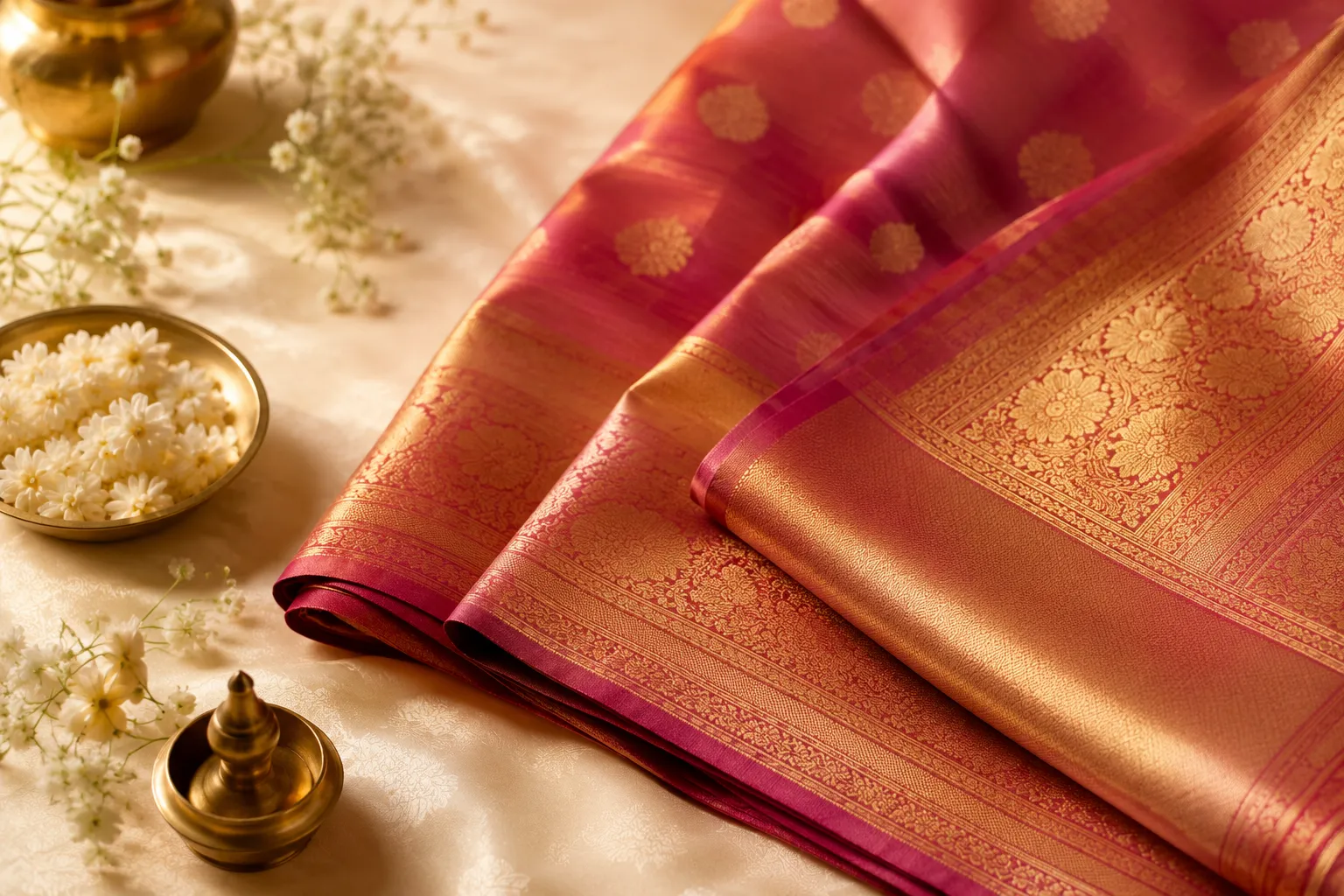
Fake silk has never been easier to sell — or harder to catch. As a result, if you want to identify pure silk sarees confidently before you buy, you need more than one test. In fact, advances in textile manufacturing mean art silk, semi-silk, and blended fabrics can now mimic the shine, drape, and even the weight of pure silk closely enough to fool an untrained eye. On top of that, online shopping means you can’t touch or smell a saree before you buy it, so even experienced buyers get misled by clever labeling.
This guide covers everything you need to identify pure silk sarees with confidence — physical tests, zari identification, weaving structure, certification, and a complete buying checklist — so you never have to guess again.
Why It Is Becoming Difficult to Identify Pure Silk Today
Growth of Artificial Silk and Blended Fabrics
As a result, manufacturers now produce art silk, soft silk, and silk-blend fabrics that closely resemble the real thing at a fraction of the cost.
Advanced Textile Manufacturing Mimics Genuine Silk
In addition, modern finishing techniques can replicate silk’s sheen and drape on synthetic yarns, making visual identification alone unreliable.
Machine-Made Weaving Closely Resembles Handloom Silk
Similarly, powerloom weaving has become precise enough that the tell-tale irregularities of handloom work are harder to spot without close inspection.
Fake Zari Looks Similar to Real Gold and Silver Zari
Likewise, metallic-coated plastic and copper-alloy threads can look identical to genuine gold and silver zari from a distance.
Online Shopping Limits Physical Inspection
For instance, you can’t perform a touch test, sound test, or burn test through a product photo — which is exactly why misleading listings persist.
Misleading Product Descriptions
For example, sellers often use terms like these to make a fabric sound more premium than it is:
- Art Silk — artificial silk, not real silk at all
- Soft Silk — usually a lighter-weight blend, not necessarily pure
- Semi Silk — a mix of silk and other fibers
- Silk Blend — silk combined with cotton, viscose, or synthetic yarn
- Satin Silk — refers to the weave (satin), not the fiber content
Lack of Consumer Awareness
However, many buyers rely on a single test — usually shine or price — and skip the more reliable checks entirely.
Increasing Counterfeit Silk Mark Labels
Even so, counterfeiters now copy certification tags too, which is why verification (covered below) matters as much as the label itself.
Why Buyers Should Rely on Multiple Identification Methods
In short, no single test is foolproof. Combining physical tests, zari checks, weave inspection, and certification gives you the most reliable picture.
Physical Identification Tests
Burn Test
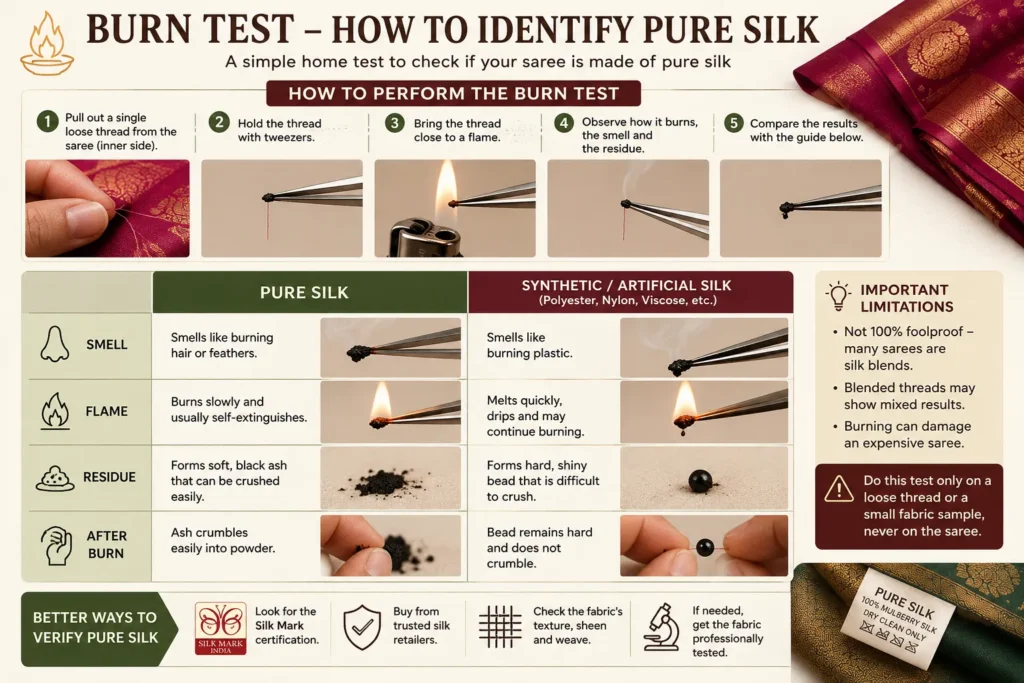
Overall, the burn test is the most commonly cited method — and, ironically, one of the most misunderstood.
How it works: Take a small thread from an inner hem or fringe (never from visible fabric), and burn it carefully over a non-flammable surface.
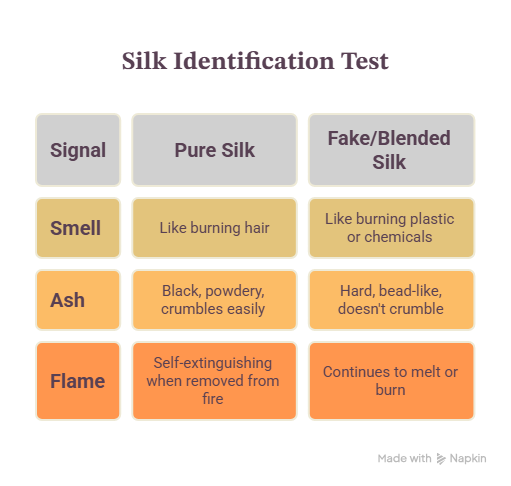
Limitations: The burn test only works on a loose thread you’re willing to destroy — it’s not something you can do before buying, and it doesn’t tell you anything about blend percentage if the saree is part-silk, part-synthetic.
Touch & Temperature Test
Beyond the burn test, a few tactile clues can help too:
- Warmth — pure silk feels warm almost instantly when you touch it; synthetic fabric feels cool
- Texture — smooth but not slippery in an artificial way; you should feel very fine, natural ridges
- Weight — pure silk has a substantial, fluid weight; art silk often feels either too light or artificially stiff
Visual Identification
Similarly, a few visual cues can help you spot genuine silk:
- Natural luster — pure silk has a soft, shifting sheen that changes with the angle of light, not a flat, uniform shine
- Prism-like light reflection — genuine silk fibers have a triangular cross-section that splits light like a prism, giving a subtle rainbow effect at certain angles
- Color depth — dyes sit differently in natural fiber, giving richer, more layered color than the flatter tone typical of synthetic dyes
Sound Test
In addition, rub a section of the fabric between your fingers or gently crumple it near your ear. Pure silk produces a distinctive rustling sound known as “scroop” — synthetic fabrics tend to stay silent or make a dull, papery sound instead.
Wrinkle Test
Likewise, gently crush a section of the saree in your hand and release it. Pure silk wrinkles naturally but the creases soften and fall out within a few minutes. Synthetic fabric, by contrast, either resists wrinkling entirely or holds sharp, stubborn creases.
Ring Test
Finally, an old jeweler’s trick: you can pull a small piece of pure silk fabric through a finger ring because of its fineness and lightness. This works best on lightweight silk and is less reliable on heavily worked or zari-embellished sarees — so treat it as a supporting signal, not a standalone proof.
Identifying Genuine Silk Zari
What Is Real Zari?
Traditionally, weavers make zari by wrapping gold or silver over a silk or cotton core, then use it for the decorative borders and motifs on a saree.
Gold and Silver Plated Zari
In practice, genuine zari today usually starts as silver thread that manufacturers electroplate with gold and wrap around a silk core — buyers often call this “tested zari.”
Scratch Test: Gently scratch the surface of the zari thread with a fingernail or blunt object. If it reveals a reddish silk thread underneath, it indicates a genuine zari core.
Fake Zari
By contrast, manufacturers typically make imitation zari from:
- Plastic-coated thread
- Copper or other metal alloys
- Synthetic polyester cores
Scratch Test Results: Fake zari usually reveals a white plastic core or a dull metallic core rather than a silk thread underneath.
[Image placeholder — alt text: “zari scratch test to identify pure silk sarees”]
Weaving & Structural Identification
Handloom vs. Powerloom
Because handloom and powerloom production differ so much, here’s how they compare:
| Feature | Handloom | Powerloom |
| Pattern | Slight natural irregularities | Perfectly uniform |
| Speed of production | Slow, artisan-made | Fast, machine-made |
| Reverse side | Threads often visibly carried across | Cleaner, more mechanical finish |
| Value | Generally higher, reflects craftsmanship | Generally lower cost |
Korvai Joint Identification
For example, korvai is a traditional technique where weavers weave the body and border of a saree separately, then interlock them together. On genuine korvai work, you can often feel a slightly raised, textured line where the border meets the body — a small but telling sign of handloom construction.
Reverse Side Inspection
As a result, when you turn the saree over and look at the back, handloom silk typically shows the zari and colored threads carrying across in a way that reveals integrated thread movement, rather than the flat, printed-looking reverse that machine-made or blended fabric often shows.
Silk Mark Certification
What Is Silk Mark?
Overall, the Central Silk Board (Government of India) issues Silk Mark certification to guarantee a product is 100% natural silk. You’ll see it as a small woven or printed label on the saree.
How to Verify Silk Mark
Therefore, each authentic Silk Mark label carries a unique number that you can check against the Silk Mark Organisation of India’s official records.
QR Code Verification
In addition, many modern Silk Mark labels include a QR code that you can scan to instantly confirm authenticity and view certification details — a useful check given the rise of counterfeit labels.
Government Certification
Beyond Silk Mark, some regional silk weaves (like Kanchipuram silk) also carry Geographical Indication (GI) tags, which further confirm both authenticity and origin.
Buying Tips for Pure Silk Sarees
Overall, here’s what to keep in mind:
- Choose trusted sellers with a track record of transparency about fabric composition
- Understand pricing — pure silk has a production cost floor; a price far below that range is a red flag
- Read the return policy before buying, especially online, in case the saree doesn’t match its description
- Avoid misleading marketing terms like “silk finish,” “silk touch,” or “premium silk blend” without asking exactly what percentage is real silk
Popular Types of Pure Silk Sarees
- Kanchipuram Silk — known for heavy zari borders and contrasting pallus, woven in Tamil Nadu
- Banarasi Silk — intricate brocade work, often with Mughal-inspired motifs, from Varanasi
- Mysore Silk — lightweight, glossy silk with minimal embellishment, from Karnataka
- Tussar Silk — a wild silk variety with a natural, textured, matte finish
- Gadwal Silk — cotton body with a silk border and pallu, from Telangana
Common Mistakes Buyers Make
- Trusting only the burn test and ignoring other signals
- Judging purity only by shine or glossiness
- Ignoring Silk Mark certification entirely
- Buying based on price alone, assuming cheaper always means fake and expensive always means real
- Confusing “soft silk” or “semi silk” labeling with pure silk
- Believing every “gold zari” claim without checking the core
Complete Checklist Before Buying Pure Silk
- Texture feels warm and smooth, not cool or plasticky
- Weight feels substantial and fluid, not artificially stiff or too light
- Rubbing the fabric produces a “scroop” sound
- Sheen shifts naturally with light rather than looking flat
- Weave shows natural handloom irregularities (if handloom is claimed)
- Zari reveals a silk (not plastic) core when you scratch it gently
- Silk Mark label is present and verifiable
- Seller has a transparent, trustworthy reputation
- Return/exchange policy is clearly stated
Conclusion
In short, no single test can confirm pure silk on its own — the burn test, touch test, zari check, weave inspection, and Silk Mark certification each tell part of the story. The most confident way to identify pure silk sarees is to combine several of these methods rather than relying on just one, and to buy from sellers who are transparent about fabric composition from the start.
Ultimately, if you’d like expert guidance before your next silk saree purchase, the team at Medhini Boutique is happy to walk you through fabric, zari, and weave details in person — so you can buy with confidence.
Frequently Asked Questions
How can you identify pure silk at home?
Combine a few simple checks: the fabric should feel warm rather than cool, produce a soft rustling “scroop” sound when you rub it, and show a natural, shifting sheen rather than a flat shine. For a more definitive check, a burn test on a loose thread from the fringe can confirm fiber content.
Does the burn test always work?
It’s a strong indicator but not foolproof, especially with blended fabrics where only part of the thread is silk. So use it alongside other checks, not as a standalone proof.
How do you identify genuine silk zari?
Gently scratch the surface of the zari thread. A reddish silk thread underneath indicates genuine zari; a white or plastic-looking core indicates imitation zari.
What is the Silk Mark certification?
The Central Silk Board issues Silk Mark as an official certification that verifies a product is 100% natural silk, and you can identify it by a labeled tag with a verifiable number or QR code.
How do you identify original Kanchipuram silk?
Look for the korvai joint technique at the border, a distinct silk-core zari, and check for a Silk Mark or GI (Geographical Indication) tag confirming Tamil Nadu origin.
Is handloom silk always pure silk?
Not necessarily. Handloom refers to the weaving method, not the fiber content — weavers can still weave a handloom saree from blended or synthetic yarn, so it’s worth checking both separately.
What is the difference between pure silk and art silk?
Silkworms produce pure silk as a natural fiber, while art silk (artificial silk) is a synthetic fiber — usually viscose or rayon-based — that manufacturers design to mimic silk’s appearance at a lower cost.
Why is pure silk expensive?
The cost reflects the labor-intensive process of silk farming, reeling, and often handloom weaving, along with the natural fiber’s durability and the value of genuine zari work.
Can fake silk pass the ring test?
Very lightweight synthetic fabric can sometimes pass the ring test too, so treat it as a supporting check rather than definitive proof on its own.
What should I check before buying a silk saree online?
Look for clear fabric composition details, Silk Mark certification, real (not stock) product photography, a transparent return policy, and seller reviews — since physical tests aren’t possible before purchase.
